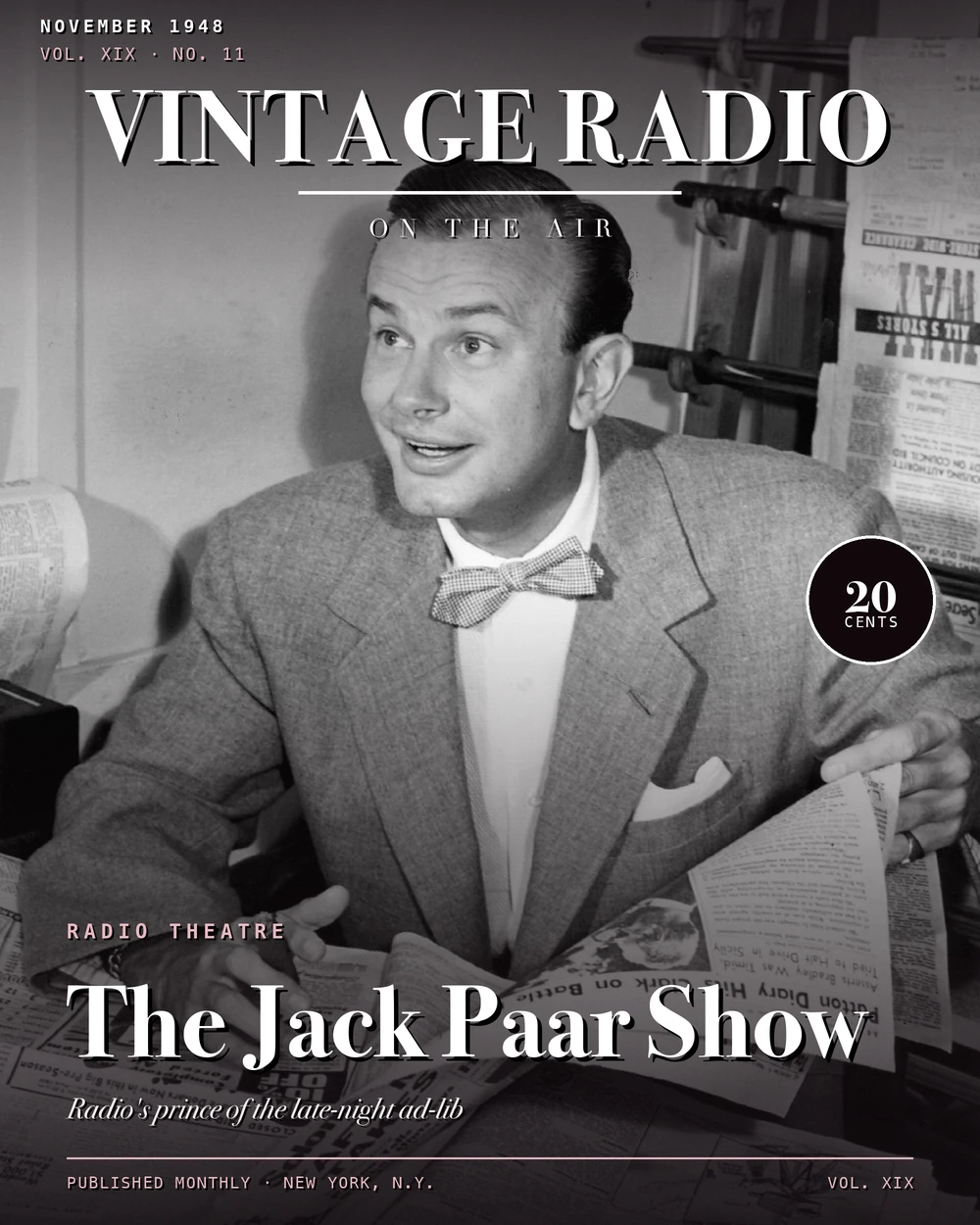
The Jack Paar Show
Before Benny Found Him
Jack Harold Paar was born May 1, 1918, in Canton, Ohio, the son of a New York Central Railroad division superintendent. The family moved to Jackson, Michigan, where Paar developed a childhood stutter he worked hard to overcome and, at fourteen, contracted tuberculosis severe enough to confine him to bed for roughly eight months. At sixteen he left Jackson High School and walked into WIBM, the local Jackson radio station, looking for work. He found it there and at a string of stations after — WJR in Detroit, WIRE in Indianapolis, WGAR in Cleveland, WBEN in Buffalo.
He was at WGAR in 1938 the night Orson Welles broadcast War of the Worlds. As panicked phone calls flooded the station, Paar went on the air to calm listeners, later recalling in his memoir that he had told them: "The world is not coming to an end. Trust me. When have I ever lied to you?" The line is pure Paar in miniature — the conversational pivot, the wink, the gentle self-mockery.
Drafted into the Army in 1943, he was assigned to the 28th Special Service Company in the South Pacific, where he worked as a wisecracking emcee alongside Jackie Cooper and built an act around mocking the undemocratic class system of military life. The enlisted men loved it; the brass less so, and Paar narrowly escaped disciplinary trouble for impersonating senior officers. War correspondent Sidney Carroll wrote up the antibrass routine for Esquire, and by the time Paar got back stateside he had multiple offers from networks and studios. He worked as a fill-in for Don McNeill on The Breakfast Club and hosted Take It or Leave It on radio. Then Jack Benny called.
Discovered on Guadalcanal
Benny had crossed paths with Paar on Guadalcanal in 1945 while entertaining troops, and what he saw stayed with him. When Benny decided to give Paar a proper launch as his 1947 summer replacement, he didn't just hand off the slot — he wanted to produce the show himself. According to Benny writer Milt Josefsberg, each of Benny's four staff writers served the new series in a rotating advisory capacity. Paar got his sendoff on the final Benny broadcast of the 1946–47 season, May 25, 1947, an episode featuring Fred Allen as guest, which guaranteed the largest possible audience for the hand-off. It was about as warm an introduction as the medium could offer.
The writing room behind Paar reflected that investment: Larry Marks, Larry Gelbart, Artie Stander, and Seaman Jacobs. Gelbart, then in his late teens and simultaneously serving with the Armed Forces Radio Service, would later write M*A*S*H and win Tonys for A Funny Thing Happened on the Way to the Forum and City of Angels. At this point he was one of several capable hands shaping what The Jack Paar Show would be.
The NBC Run
The show premiered on NBC on June 1, 1947, Sundays at 7 PM, a half hour sponsored by Lucky Strike — the same American Tobacco money that backed Benny, which meant real commercial continuity behind the transition. The cast included Elvia Allman and Lionel Stander alongside other Hollywood players, with Hy Averback announcing, Jerry Fielding leading the orchestra, Trudy Erwin as vocalist, and the Page Cavanaugh Trio providing vocal support. Bob Nye produced. The show ran through September 28, 1947.
Two members of that cast and crew carried political weight that would catch up with them. Lionel Stander, known for his raspy voice and openly left-wing politics, was blacklisted from films in the late 1940s after being subpoenaed by HUAC — and Jerry Fielding, the show's musical director, would meet nearly the same fate when he was called before the committee in December 1953 and blacklisted from network radio and television for close to a decade. Fielding eventually rebuilt his career in film, scoring The Wild Bunch, Straw Dogs, and The Outlaw Josey Wales. But in 1947 both men were simply working comedy talent, and the show drew good notices — Time among them — with critics finding the comedy reminiscent of Benny's. Given the lineage, that was a compliment, and most of the press took it that way.
The ABC Chapter and Its Abrupt End
When Benny returned to NBC in the fall, American Tobacco decided to keep Paar's show going rather than let it lapse. The show moved to ABC, airing Wednesdays at 9:30 PM beginning October 1, 1947. The summer-replacement momentum was gone; Paar was now competing on his own terms.
The run lasted until December 24, 1947, and its cancellation had a particular cause. A consultant had pushed Paar to develop some kind of running weekly gimmick — a hook the show could hang its identity on. That advice grated. Paar publicly stated that he wanted to get away from the kind of old-hat comedy being practiced by Jack Benny and Fred Allen. For a performer who owed his start entirely to Benny's sponsorship, it was a striking thing to say, and Lucky Strike canceled the show not long after. The "spoiled kid" image that would follow Paar throughout his career found its early foothold here — biting the hand that had just fed him, in a way that was clearly traceable.
The Years Between
The nine years between Paar's two radio series weren't idle. Howard Hughes signed him as a contract player at RKO, where he made his screen debut as emcee in Variety Time (1948) and went on to appear in Easy Living (1949), Walk Softly, Stranger (1950), and Love Nest (1951), in which he played Marilyn Monroe's boyfriend. He hosted Take It or Leave It on CBS Radio in 1950–51 — the show whose top prize gave the $64 Question its name — appeared as a panelist on The $64 Question, and again filled in for Don McNeill on The Breakfast Club.
Television absorbed most of the rest. He hosted Up to Paar on NBC in 1952, Bank on the Stars on CBS and then NBC in 1953–54, and The Morning Show on CBS in 1954, where he replaced Walter Cronkite. A daytime Jack Paar Show on CBS ran weekday afternoons until May 1956. He was, in short, continuously visible — just never quite finding the right room.
A Very Different Return to Radio
When Paar came back to radio proper, the format couldn't have been further from the 1947 show. From July 2, 1956 to March 29, 1957, he hosted a disc jockey program on ABC, weekdays in a 15-minute slot at 11 or 11:15 AM. Paar called it "so modest we did it from the basement rumpus room of our house in Bronxville." That wasn't false modesty. The cast included his wife Miriam, his daughter Randy, his dog Schnaaps, and his old army friend José Melis, the Havana-born Juilliard graduate who had been Paar's musical director since they'd met during the war and would follow him to The Tonight Show.
The contrast with 1947 is striking. The earlier show had a full orchestra, a vocal group, Hollywood guest players, a prime NBC slot, and the promotional machinery of Jack Benny behind it. The disc jockey show had none of that. What it did have was an intimacy that suited Paar's conversational style — the same quality that would shortly make him a natural fit for late-night television.
What Came Next
On July 29, 1957, four months after the disc jockey show ended, Paar took over NBC's Tonight Show from Steve Allen and expanded its affiliate base from 46 stations to 170. The personality he had been developing through a decade of false starts — quick, occasionally combative, personal in a way that caught audiences off guard — finally found its platform. His catchphrase "I kid you not," lifted from Humphrey Bogart's Captain Queeg in The Caine Mutiny, became a national tag. The careers he helped launch in those five years made up a generational roster: Carol Burnett, Woody Allen, Liza Minnelli, Bill Cosby, Bob Newhart, Dick Gregory, Godfrey Cambridge, the Smothers Brothers, and Jim Henson with the Muppets.
The persona that had gotten him in trouble in 1947 was now the act. On February 11, 1960, after NBC censors cut a "W.C." joke from his monologue without telling him, Paar walked off the show on the air. He stayed gone for five weeks. When he returned, he opened with: "As I was saying...." He left the Tonight Show on March 30, 1962, having hosted more than 2,000 hours of programming. Variety's Abel Green called him "the most vivid personality in TV since Milton Berle became Mister Television" and credited him as the first popular entertainer since the creators of Amos 'n' Andy to change the habits of a nation. Time's obituary in January 2004 put it more memorably: "His fans would remember him as the fellow who split talk show history into two eras: Before Paar and Below Paar."
The 1947 radio show documents the early version of all of that — a performer with real talent handed ideal conditions and still managing to fumble the landing, because the instinct for self-sabotage was already as well developed as the gift. The tension between the two ran through everything that came after. It was already visible here.